Documentation
Cyclic
This type of event is executed at a specific time and is repeated cyclically. The point of time is defined by a combination of "Day Pattern" and "Time Pattern".

Scripts that are run by a cyclic event offer these System Variables
Day Pattern:
There are 5 different options
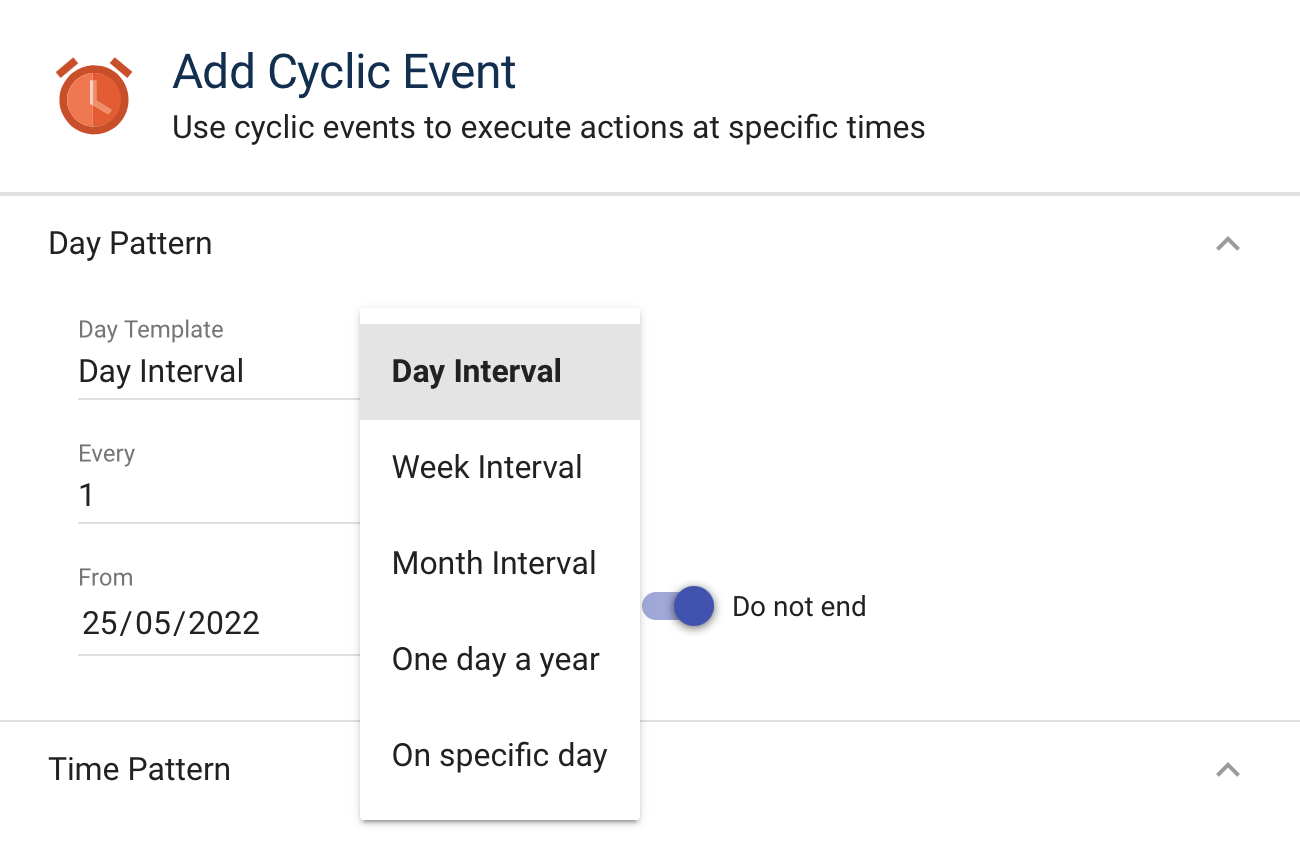
| Day Pattern | Description |
|---|---|
| Day Interval | Defines a day interval (1 = every day; 2 = every second day; ...) in which the event is executed. |
| Week Interval | Defines a week interval (1 = every week; 2 = every second week; ...) and the days in which the event is executed. |
| Month Interval | Defines a month interval (1 = every month; 2 = every second month; ...) and the days in which the event is executed. |
| One day a year | Defines a specific day in the year on which the event is executed. |
| On specific day | Defines a specific date on which the event is executed. |
Time Pattern:
There are 4 different options
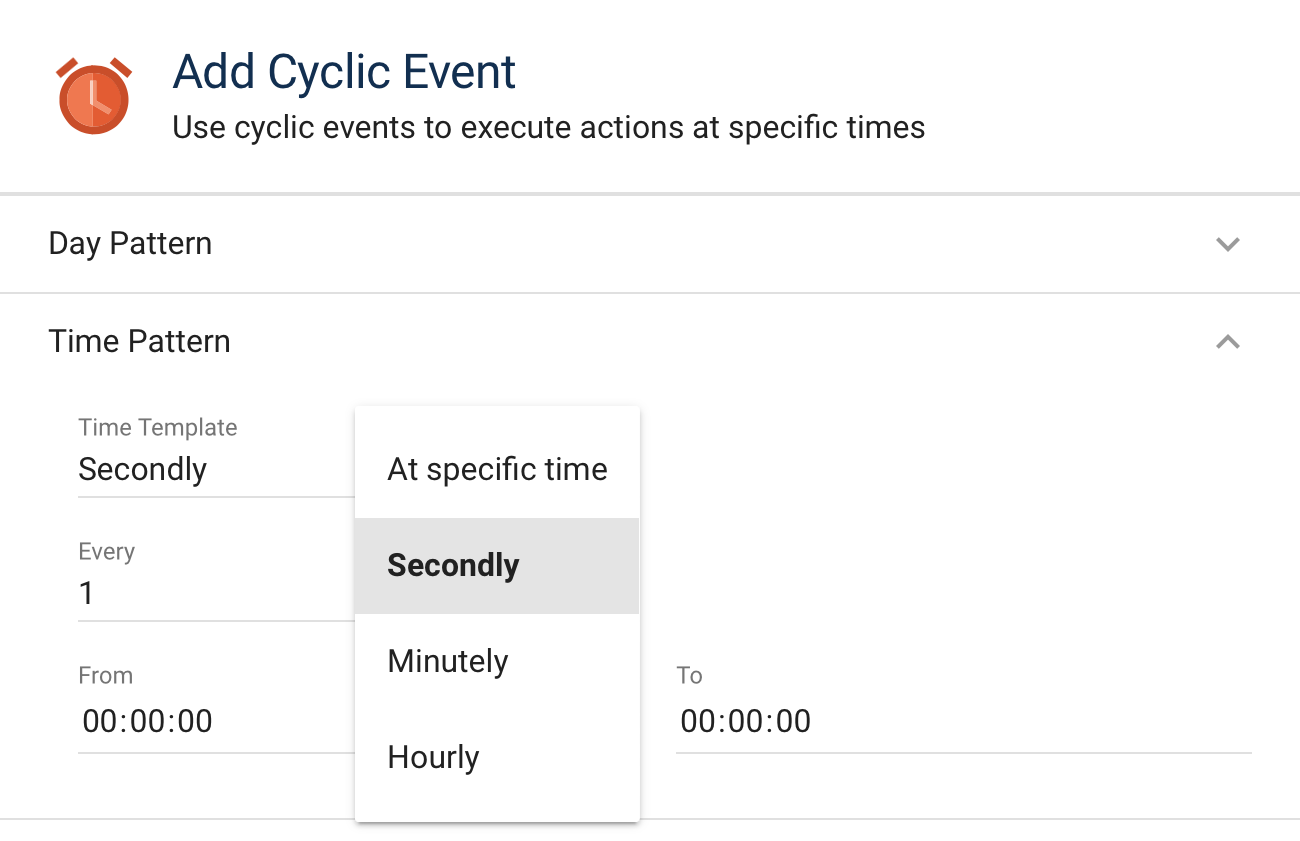
| Time Pattern | Description |
|---|---|
| At specific time | Defines a specific time on which the event is executed. |
| Secondly | Defines a second interval on which the event is executed. |
| Minutely | Defines a minute interval on which the event is executed. |
| Hourly | Defines an hour interval on which the event is executed. |
Special Options:
From/To:
It is possible to define start and end time.
| Setting | Description |
|---|---|
| On Day Pattern | Defines the date interval in which the event is active. |
| On Time Pattern | Defines the daily interval in which the event is active. |
| From | Start Time = Defines the beginning of the interval. |
| To | End Time = Defines the end of the interval. |
| "Do not end" | No end time. If deactivated, the "To" option is displayed. |
Daylight saving time
Day and time patterns always refer to the local time of the configured time zone. When the clocks change, there is a time that does not exist (standard time to daylight saving time) or a time that occurs twice (daylight saving time to standard time). The following examples apply to the time zone Europe/Berlin, where the clocks are put forward from 02:00 to 03:00 on the last Sunday in March and put back from 03:00 to 02:00 on the last Sunday in October.
Standard time to daylight saving time
The times from 02:00:00 to 02:59:59 do not exist. An event that would be triggered within this period is executed once at 03:00:00 (daylight saving time).
| Event | Execution on the day of the change |
|---|---|
| At specific time 01:30:00 | 01:30:00 (standard time) |
| At specific time 02:00:00 | 03:00:00 (daylight saving time) |
| At specific time 02:30:00 | 03:00:00 (daylight saving time) |
| At specific time 03:00:00 | 03:00:00 (daylight saving time) |
| Minutely with value 15 | ..., 01:45:00, 03:00:00, 03:15:00, ... |
Daylight saving time to standard time
The times from 02:00:00 to 02:59:59 occur twice. An event is only executed during the first pass (daylight saving time). Events with a second, minute or hour interval therefore pause during the second hour and continue at 03:00:00 (standard time).
| Event | Execution on the day of the change |
|---|---|
| At specific time 02:00:00 | 02:00:00 (daylight saving time) |
| At specific time 02:30:00 | 02:30:00 (daylight saving time) |
| At specific time 03:00:00 | 03:00:00 (standard time) |
| Minutely with value 15 | ..., 02:45:00 (daylight saving time), 03:00:00 (standard time), ... |
If the next execution is recalculated during the repeated hour, e.g. because the event was changed or Symcon was restarted, the second pass (standard time) is used. An event that has already been executed during daylight saving time can therefore be triggered a second time.
Examples:
Every friday at 09:00:
Day Pattern = Weekly with value one and Friday checked
Time Pattern = At specific time with 09:00:00
Every 5 minutes from 12:02:10 until 16:00:00:
Day Pattern = Daily with value 1
Time Pattern = Minutely with value 5
From: 12:02:10 To: 16:00:00
No hook at "Do not end"
First execution at 12:02:10
Second execution at 12:07:10
...
--continuing until-->
...
Last execution at 15:57:10